Does Geography Decide Plant Economics?
A unit-operation case study comparing a 100 TPD WNA-to-CNA extractive distillation train (Mg(NO₃)₂ dehydration route) at an inland, higher-altitude site (Nangal, Punjab) against a humid coastal site (Paradip, Odisha).
A unit-operation case study comparing a 100 TPD weak-to-concentrated nitric acid (WNA→CNA) extractive distillation train using Mg(NO₃)₂ dehydration at an inland, higher-altitude site (Nangal, Punjab) against a humid coastal site (Gopalpur, Odisha). Five physical dimensions, five surprises.
When we choose where to build a chemical plant, the conversation usually jumps straight to feedstock availability, logistics, land cost, and government incentives. The thermodynamics of the site — its ambient temperature, atmospheric pressure, and humidity — rarely get a number attached to them. They get hand-waved as “the engineers will handle it.”
This article puts a number on it. The answer is more interesting than “harsh coastal climate costs more.” Every physical lever turns out to fight a counter-lever, and the naive intuition is wrong as often as it is right.

Sea level · ~5 m · 101.3 kPa
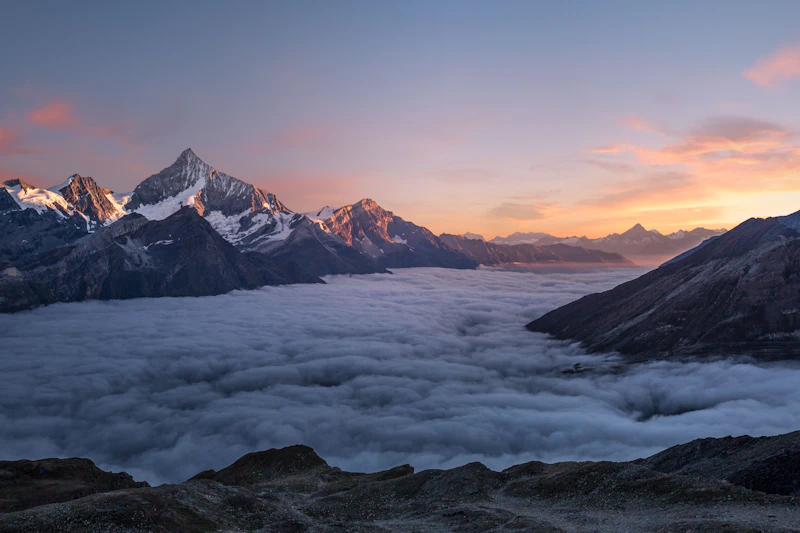
~355 m elevation · 97.1 kPa
The Two Sites
Two locations chosen to represent contrasting Indian industrial geographies: Nangal (Punjab) — a well-established chemicals corridor at ~355 m elevation; and Gopalpur (Odisha) — a coastal site effectively at sea level, representative of the eastern industrial corridor that includes Paradip and Kalinganagar.
| Parameter | Nangal — Inland | Gopalpur — Coastal |
|---|---|---|
| Altitude | ~355 m | ~5 m |
| Atmospheric pressure | 97.1 kPa | 101.3 kPa |
| Annual avg dry-bulb temp | ~25 °C | ~30 °C |
| Relative humidity | ~55% | ~80% |
| Wet-bulb temperature | ~18.8 °C | ~27.1 °C |
| Avg wind speed | ~3.5 m/s | ~2.5 m/s |
Dimension 1 — Altitude, Pressure, and Boiling Point
The CNA column operates near atmospheric pressure, so local barometric pressure sets boiling temperatures directly. Nangal’s elevation lowers atmospheric pressure to ~97.1 kPa versus Odisha’s ~101.3 kPa. Using a Clausius–Clapeyron estimate anchored at a ~135 °C reboiler bottoms at sea level:
- Nangal bottoms boil at ~133.6 °C
- Gopalpur bottoms boil at ~135.0 °C
A difference of 1.4 °C. The naive expectation — “lower boiling point at altitude saves energy” — is directionally correct but quantitatively negligible. The contribution to sensible heat is ~1 kcal/kg, compared to latent heat of ~350 kcal/kg.
Dimension 2 — Reboiler Steam
The reboiler duty has two parts: a separation (latent) duty that breaks the water–acid azeotrope, essentially site-independent at ~2.6 GJ per tonne of CNA; and a sensible duty to heat the incoming feed to boiling temperature. Here geography produces a small but counterintuitive twist.
Odisha’s warmer ambient temperature — and therefore warmer feed — means the feed arrives closer to its boiling point. Less sensible reheat is needed. The coast, paradoxically, is the cheaper site for steam:
| Component | Nangal | Gopalpur |
|---|---|---|
| Sensible feed heat-up | ~133 GJ/day | ~122 GJ/day |
| Separation latent duty | ~260 GJ/day | ~260 GJ/day |
| Total reboiler duty | ~393 GJ/day | ~382 GJ/day |
| Steam consumption | ~59,800 t/yr | ~59,200 t/yr |
| Steam cost @ ₹2,500/t | ₹15.18 Cr/yr | ₹14.81 Cr/yr |
Dimension 3 — Cooling Tower Load and the Wet-Bulb Penalty
This is where the coast is supposed to suffer badly — and where the physics becomes genuinely subtle.
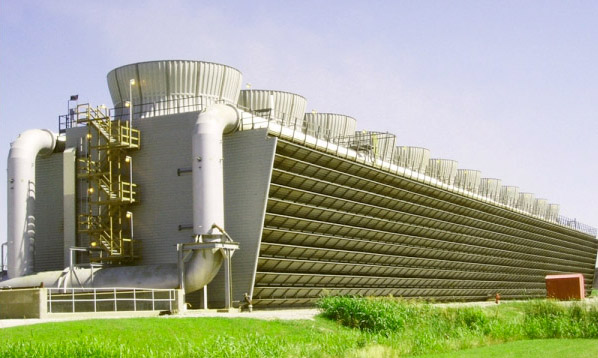
A wet cooling tower rejects heat almost entirely by evaporating a fraction of circulating water. The floor on how cold it can make the return water is the wet-bulb temperature, not the dry-bulb. Odisha’s 80% humidity pushes wet-bulb to ~27 °C against Nangal’s ~19 °C, and also worsens the achievable approach:
| Parameter | Nangal | Gopalpur |
|---|---|---|
| Wet-bulb temperature | 18.8 °C | 27.1 °C |
| Tower approach | ~4.3 °C | ~5.8 °C |
| Cold water supplied | ~23.1 °C | ~32.9 °C |
Odisha loses nearly 10 °C of cold-water temperature purely to humidity — far larger than the 1.4 °C boiling-point difference. Warmer cold water means a warmer condenser and, on peak monsoon days, a real risk of column de-rating.
The Evaporation Surprise
You would expect the humid site to evaporate more cooling water. A psychrometric mass-and-energy balance says otherwise:
| Parameter | Nangal | Gopalpur |
|---|---|---|
| Inlet air humidity | 11.4 g/kg | 21.6 g/kg |
| Exit air (saturated) | 24.8 g/kg | 32.8 g/kg |
| Moisture pickup per kg air | 13.4 g/kg | 11.2 g/kg |
| Air mass flow required | ~173 kg/s | ~127 kg/s |
| Evaporation rate | ~5.8 m³/h | ~5.1 m³/h |
| Annual evaporation | ~45,800 m³/yr | ~40,400 m³/yr |
Fan Power — The Counter-Intuitive Result
Fan shaft power is set by volumetric air flow against tower draft loss. Taking the psychrometric mass flows above and converting to volume (using moist-air density at each site, 180 Pa draft loss, 65% fan efficiency):
| Parameter | Nangal | Gopalpur |
|---|---|---|
| Air mass flow required | 173 kg/s | 127 kg/s |
| Moist-air density | 1.127 kg/m³ | 1.149 kg/m³ |
| Volumetric air flow | 153 m³/s | 110 m³/s |
| Fan shaft power | ~42 kW | ~31 kW |
| Fan power cost @ ₹7/kWh | ~₹0.235 Cr/yr | ~₹0.169 Cr/yr |
This overturns the obvious guess. Nangal — the dry inland site — spends more on air-moving, for two reinforcing reasons:
- Odisha needs less air mass. Its warm, saturated exit air is enthalpy-dense, shedding the same ~4 MW with only 127 kg/s versus Nangal’s 173 kg/s.
- Odisha’s air is denser, not thinner. Sea-level pressure (101.3 kPa) outweighs the temperature and humidity effects, so coastal air is denser (1.149 vs 1.127 kg/m³) — the opposite of the “thin humid air” intuition.
The caveat that keeps the wet-bulb story alive: this steady-state analysis assumes the tower can find its optimum. On a peak monsoon day when Odisha’s wet-bulb climbs toward 28–29 °C, the air’s spare moisture capacity collapses and a fixed-fan tower can no longer extract enough heat. The de-rating risk is real; it is the steady-state fan cost that runs the other way.
Cooling Subtotal
| Component (₹ Cr/yr) | Nangal | Gopalpur |
|---|---|---|
| Fan power (air moving) | 0.235 | 0.169 |
| Pump power (circulation) | 0.235 | 0.235 |
| Makeup water | 0.256 | 0.227 |
| Cooling subtotal | 0.727 | 0.631 |
Dimension 4 — Heat Loss and Insulation
Hot equipment (column shell, reboiler, Mg(NO₃)₂ reconcentrator, piping; ~460 m² of surface at ~133 °C) loses heat to ambient. Cold-winter Nangal should bleed more standby heat than warm Odisha.
It barely does. With standard 50 mm mineral-wool insulation at both sites:
| Parameter | Nangal | Gopalpur |
|---|---|---|
| Annual heat loss | ~1,216 GJ/yr | ~1,190 GJ/yr |
| Make-up heat cost | ~₹0.15 Cr/yr | ~₹0.15 Cr/yr |
OPEX Comparison — Grand Total
Operating Cost Summary — 100 TPD CNA Plant
| Component (₹ Crore/yr) | Nangal | Gopalpur | Direction |
|---|---|---|---|
| Reboiler steam | 15.18 | 14.81 | → Coast wins |
| Cooling — fan power | 0.235 | 0.169 | → Coast wins |
| Cooling — pump power | 0.235 | 0.235 | → Tie |
| Cooling — makeup water | 0.256 | 0.227 | → Coast wins |
| Heat loss / insulation make-up | 0.15 | 0.15 | → Tie |
| Operating subtotal | 16.06 | 15.59 | Odisha ↓₹0.47 |
On pure operating cost, Odisha is ~₹0.47 Cr/yr cheaper — about 3%. Steam saving and lower air-moving and water costs all favour the coast. Once higher coastal capex (corrosion allowance, larger tower cross-section) is amortised in, the two sites are near a dead heat (~₹0.15 Cr/yr apart, Odisha still marginally ahead).
The Real Conclusion — Geography Sets Failure Modes, Not Cost
Across five physical dimensions, the geographic effect on CNA distillation economics is real but small — on the order of a few percent — and every lever fights a counter-lever:
- Boiling point: altitude helps Nangal by only 1.4 °C — negligible.
- Steam: warmer feed helps Odisha — a small coastal win.
- Cooling: wet-bulb hurts Odisha as a peak-day reliability risk, but in steady state the coast moves less air and evaporates less water — fan and water bills are lower, not higher.
- Insulation: the cold-site heat-loss penalty is erased by 50 mm of wool.
- Capex: coastal corrosion allowance and a larger tower cross-section cost Odisha ~₹2.5 Cr more to build.
The levers nearly cancel. What geography actually does is relocate where the engineer must pay attention — toward cooling-water system design and peak-day wet-bulb de-rating at the coast, and toward (trivial) winter insulation inland.
The cost drivers that genuinely dominate are not climatic. A ₹200/tonne difference in steam tariff would swing the answer by ~₹1.2 Cr/yr — several times the entire five-dimension climate signal combined.
“Design for the wet-bulb, buy the cheaper steam, and don’t let the boiling-point arithmetic decide your site.” — Saswat Satpathy, Orissa Engineering
Method & Caveats
- Separation (latent) duty of 2.6 GJ/t, saturated-exit assumption (Twb + 6 °C), 460 m² hot surface area, and capex line items are sound engineering approximations — not licensor or vendor-guaranteed data.
- Wet-bulb estimated using the Stull correlation; cooling-tower evaporation via psychrometric mass-and-energy balance; fan shaft power from volumetric air flow against ~180 Pa tower draft loss at 65% fan efficiency; boiling points via Clausius–Clapeyron.
- Utility prices (steam ₹2,500/t, power ₹7/kWh, water ₹35/m³) held equal between sites deliberately, to isolate the physics. In reality these differ by site and would dominate the comparison.
- For a bankable study, replace assumed climate normals with site meteorological data, duties with licensor heat-and-mass balances, and utility prices with actual local tariffs.
Planning a plant in Eastern India?
Orissa Engineering provides site selection techno-economics, lender’s technical advisory, and owner’s engineer services.
Discuss a Project
Message sent successfully
Thank you for reaching out. We will review your project details and get back to you within 1 business day.