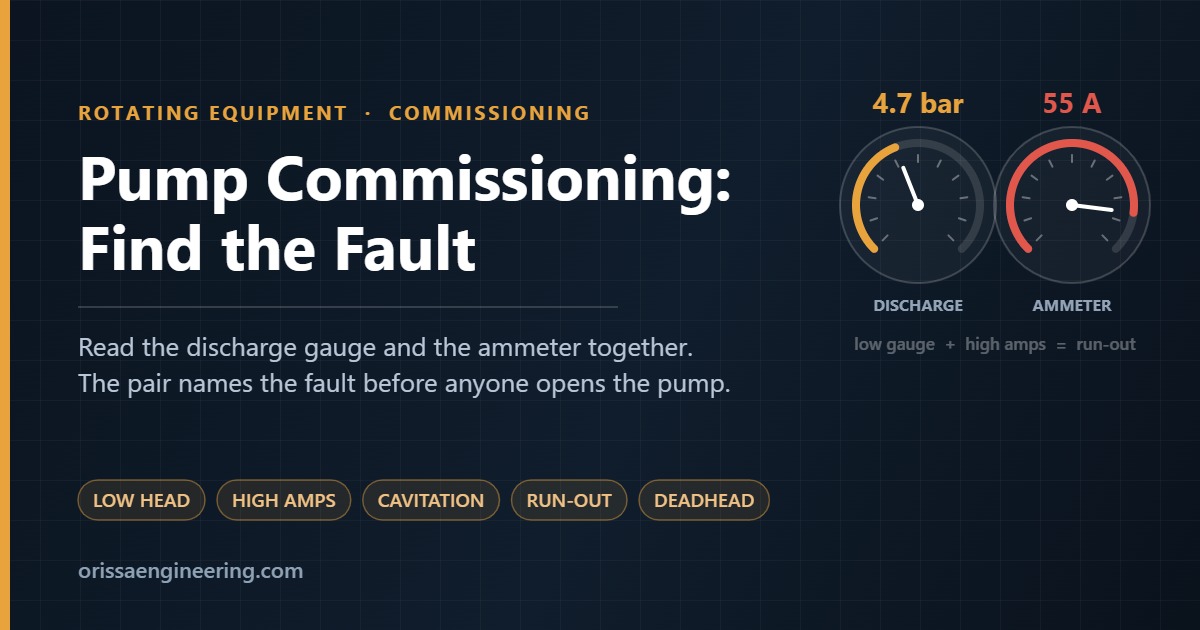
Four months on the plinth. Alignment signed off. Motor solo run clean. Suction flushed, temporary strainer in, discharge valve cracked two turns. The operator presses start. The motor pulls, settles — and stops matching the datasheet. The discharge gauge climbs to 4.7 bar and parks there; it should be near 6.5. The ammeter drifts past 55 A and keeps climbing. And the sentence gets said, the way it gets said at every commissioning: the pump is faulty, the engineering is wrong, we can’t take it into production.
It almost never is. What is actually happening is that the plant is telling you, for the first time and very loudly, what its real hydraulics look like — as against the ones calculated in an office before the plant existed. A first run is not a verification step; it is a measurement, and it is the cheapest moment the plant will ever offer to find and fix whatever is wrong. By the end of this page you should be able to walk up to a pump on its first run, read the gauges and the ammeter together, name one specific fault, prove it with a single test, and know which fix applies.
Three instruments, one equation
Everything below comes out of one statement: Pshaft = ρ·g·Q·H / η. The pump makes metres of whatever fluid is inside the impeller; the gauge reads bar; density is the bridge between them. That also makes the ammeter a density meter and a flowmeter at the same time — which is why the first rule of first runs is: read the discharge gauge and the ammeter together, never separately. A low gauge with low current means the pump is not moving liquid. A low gauge with high current means it is moving far too much. Those are opposite problems, and the bench below is built around telling them apart.
The commissioning bench
Enter the pump you are standing in front of. The bench draws the expected curve, places your gauge and ammeter readings on it, and then walks you from the deviation you can see to the one fault that explains it — and its fix.
Step 1 — The pump you are standing at
Nameplate data is enough. The bench generates an indicative expected curve from it — confirm against the vendor’s tested curve before any final decision.
Step 2 — What the instruments say (optional, but this is where the bench earns its keep)
Type what you actually read on the running pump. The bench places the point on the curve and reads the gauge and ammeter together for you.
Reference numbers — the step table
Record exactly this triplet — suction pressure, discharge pressure, current — at each valve step on the real run. Three filled rows are usually enough to name the fault.
Step 3 — Pick the deviation you can see
Each card lists what that deviation can mean; the questions then separate the candidates one test at a time.
Reference model: shut-off head ≈ 0.57·u²/g, shut-off ≈ 1.2 × BEP head, pump η ≈ 75% at BEP, motor η ≈ 93%. Fault patterns are indicative shapes for recognition, not predictions. Always confirm against the manufacturer’s tested curve.
What the faults look like inside the machine
The bench names a fault code; these are the six mechanisms behind most first-run arguments, drawn at the part of the machine where they actually happen. Pick a deviation card in Step 3 and the matching sketch also appears beside the verdict.
Before you name a culprit
Whatever the bench suggests, prove it with its discriminating test before acting — vent and restart, raise the level, put a tachometer on the shaft, dead-head for a minute and read the gauge. And record the run: suction pressure, discharge pressure and current at each valve step. That one sheet turns a rough first morning into an engineering document — the plant’s real curve, measured while the correction is still cheap — and it is the difference between fixing a pump and arguing about one.
Tell me about your pump
If a pump on your plant is not doing what the datasheet says — low head, high current, cavitation, a first run that will not hold flow — describe it below. The message goes straight to my inbox at saswatsatpathy080390@gmail.com. Give me the duty, what the discharge gauge and the ammeter read, and what changed. That pair of readings is usually enough to name the fault family before anyone opens the pump.
No obligation, and no mailing list. Your details are used only to answer your question.